
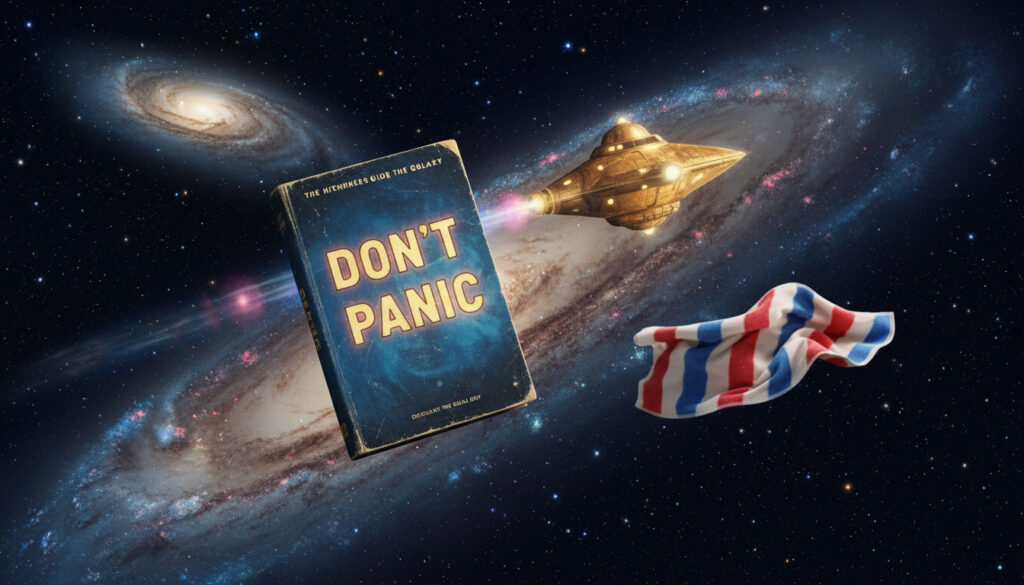
The Hitchhiker’s Guide to the Galaxy began as a 1978 BBC Radio 4 comedy series before expanding into a multimedia phenomenon spanning novels, television, film, and stage. Created by Douglas Adams, the franchise follows Arthur Dent, an unwitting human traveler, through a cosmos defined by bureaucratic absurdity, improbable technology, and the search for meaning in an indifferent universe.
Central to the narrative is the revelation that the Answer to the Ultimate Question of Life, the Universe, and Everything is the number 42, calculated by the supercomputer Deep Thought after 7.5 million years. The work satirizes science fiction tropes while exploring themes of randomness, existential futility, and the inadequacy of language to capture universal truth.
The series originated from Adams’ fusion of comedy and science fiction, debuting during a period when radio drama remained a vital British art form. Its evolution across formats—from audio broadcasts to a “trilogy” of five novels—demonstrates unique adaptability, with each iteration introducing narrative variations while maintaining core philosophical questions about humanity’s place in the galaxy.
What Is The Hitchhiker’s Guide to the Galaxy?
The narrative structure subverts traditional space opera conventions. Arthur Dent’s journey begins with the destruction of Earth by the Vogons, a bureaucratic alien race clearing path for a hyperspace bypass. Rescued by Ford Prefect, a researcher for the eponymous electronic guidebook, Dent traverses the galaxy aboard the Heart of Gold, encountering inept deities, depressed androids, and the lingering mystery of why 42 constitutes ultimate knowledge.
- Originated as a BBC radio comedy series in 1978 before novelization
- 42 functions as an intentionally absurd answer to existential inquiry, devoid of cryptic mathematical significance
- Influenced computational mathematics and tech culture, including MIT’s 2019 solution to the “sum of three cubes” problem referencing Deep Thought
- Comprises five novels by Adams, frequently termed a “trilogy in five parts”
- Multiple development attempts preceded the 2005 theatrical release
| Defining Phrase | “Don’t Panic” (appears in large, friendly letters on the Guide’s cover) |
|---|---|
| Ultimate Answer | 42 (calculated by supercomputer Deep Thought) |
| Primary Vessel | Heart of Gold (powered by the Infinite Improbability Drive) |
| Original Author | Douglas Adams (completed five volumes before his death) |
| Scope | Radio series, five novels, TV adaptation, feature film, stage productions |
| Original Publisher | Pan Books (novel edition) |
Who Wrote The Hitchhiker’s Guide to the Galaxy and Its Publication History?
Douglas Adams conceived the series while working as a radio producer and scriptwriter. The initial concept emerged from a drunken revelation about cosmic insignificance, which Adams developed into a pilot episode commissioned by BBC Radio 4. The immediate success prompted expansion into literature, though Adams famously struggled with deadlines, once remarking that he loved the sound of deadlines as they “whooshed” past.
The BBC Radio Genesis
The original radio broadcast debuted in 1978, featuring Peter Jones as the Book narrator and Simon Jones as Arthur Dent. The BBC Radio 4 production utilized innovative audio techniques to convey the Infinite Improbability Drive and Vogon poetry, establishing the tonal blend of dry wit and cosmic wonder that defined subsequent adaptations.
The 1979 novel adapted and expanded radio scripts, introducing Scrabble-related plot points regarding the Ultimate Question that did not appear in the original broadcasts. Adams revised continuity across formats, treating each version as a distinct iteration rather than strict canon.
The “Trilogy” Expands
Between 1979 and 1992, Adams published five volumes: The Hitchhiker’s Guide to the Galaxy (1979), The Restaurant at the End of the Universe (1980), Life, the Universe and Everything (1982), So Long, and Thanks for All the Fish (1984), and Mostly Harmless (1992). The series page on Wikipedia documents how the “trilogy” joke originated with the second book’s marketing, persisting through subsequent volumes despite mathematical inconsistency.
What Does 42 Mean in The Hitchhiker’s Guide to the Galaxy?
Within the narrative, 42 represents the definitive Answer to the Ultimate Question of Life, the Universe, and Everything, computed by the supercomputer Deep Thought after 7.5 million years of continuous calculation. The machine reveals this number to philosophers seeking cosmic understanding, prompting them to recognize they never properly formulated the Question itself.
Narrative Context
The paradox of possessing the Answer without the corresponding Question drives plot mechanics across multiple volumes. Characters discover that the Question and Answer cannot coexist within the same universe without causing its destruction. In Life, the Universe and Everything, the character Prak confirms through divine revelation that the Question and Answer are mutually incompatible.
Authorial Intent
Adams consistently maintained that he selected 42 arbitrarily as an “ordinary, funny number” while commuting to work, inspired by a John Cleese sketch requiring a mundane punchline. Documentation of Adams’ statements confirms he rejected fan theories connecting 42 to binary code (101010), ASCII asterisks, cricket laws, or Lewis Carroll references. Stephen Fry claimed Adams confided a “fascinating” secret explanation, though this remains unverified.
Main Characters in The Hitchhiker’s Guide to the Galaxy
The ensemble operates as foils against Arthur Dent’s bewildered human perspective. Ford Prefect, actually a Betelgeusian researcher stranded on Earth, provides entry into galactic society through his work updating the electronic Guide. Zaphod Beeblebrox, the two-headed Galactic President who stole the Heart of Gold, embodies chaotic narcissism, while Trillian (Tricia McMillan), a human astrophysicist, represents scientific competence amidst universal absurdity.
Arthur Dent and Ford Prefect
Arthur functions as the relatable Everyman, perpetually clad in his dressing gown while navigating the destruction of his planet. Ford, despite his human-sounding pseudonym derived from a misidentified vehicle, demonstrates encyclopedic knowledge of galactic culture coupled with questionable survival strategies.
The electronic Hitchhiker’s Guide sells millions more copies than its competitor The Encyclopedia Galactica by being slightly cheaper and displaying the reassuring cover message: “Don’t Panic.” This philosophy of practical calmness recurs as thematic counterpoint to cosmic terror.
Marvin and Mechanical Consciousness
Marvin the Paranoid Android possesses a “brain the size of a planet” yet performs menial tasks, resulting in severe depression and existential resentment. His diatribes about unappreciated intelligence provide commentary on artificial consciousness and labor alienation.
Vogon Poetry ranks as the third worst in the universe. Prostetnic Vogon Jeltz recites verses such as “Oh frettled gruntbuggly” to torture captives. Resistance to this poetry requires exceptional mental fortitude or deafness.
Galactic Bureaucracy
The Vogons embody administrative evil, destroying Earth not through malice but through bureaucratic procedure. Slartibartfast, the Magrathean coastline designer who crafted Norway’s fjords, offers historical perspective on Earth’s function as a computational matrix designed to discover the Ultimate Question.
The Heart of Gold utilizes the Infinite Improbability Drive, generating events like transmuting missiles into a sperm whale and a bowl of petunias. This technology enables plot developments that defy conventional causality while maintaining internal narrative logic.
How Did The Hitchhiker’s Guide to the Galaxy Evolve Across Formats?
- : Original BBC Radio 4 series broadcasts (6 episodes), establishing the audio aesthetic and voice cast.
- : Novelization published by Pan Books, reaching international audiences and establishing the “trilogy” joke.
- : BBC Television adaptation (6 episodes) brings visual representation to the Vogons and Marvin’s design.
- : Sequential publication of novels 2–5, expanding the narrative through time travel and multidimensional cricket.
- : Douglas Adams dies of a heart attack aged 49, leaving a partially completed sixth manuscript.
- : Feature film directed by Garth Jennings releases, starring Martin Freeman, Zooey Deschanel, and Sam Rockwell.
- : And Another Thing… published, written by Eoin Colfer with estate approval, concluding the arc Adams began.
What Is Known for Certain About The Hitchhiker’s Guide to the Galaxy?
| Established Information | Uncertain or Disputed |
|---|---|
| 42 was chosen randomly by Adams for absurdity without hidden mathematical meaning | Whether Stephen Fry possesses a verifiable “secret” explanation from Adams |
| Radio series originated in 1978 via BBC Radio 4 | Precise content of Adams’ unfinished sixth novel manuscript |
| Five completed novels written solely by Douglas Adams | Canonical status of Colfer’s 2009 continuation among purist fans |
| Douglas Adams died in 2001 before completing his intended sixth volume | Specific details of the “Ultimate Question” had Adams completed the series |
What Is the Cultural Impact of The Hitchhiker’s Guide to the Galaxy?
The franchise permeated geek culture through recurring symbols: the towel as the most useful interstellar object, the “Don’t Panic” mantra adopted by tech communities, and 42 as shorthand for existential mystery. MIT mathematicians acknowledged the series in 2019 when solving 42 as the sum of three cubes, a computational achievement explicitly framed as fulfilling Deep Thought’s fictional calculation.
Annual Towel Day on May 25 commemorates Adams’ death in 2001, with fans carrying towels to demonstrate preparedness for galactic travel. References appear in diverse media, including A Discovery of Witches and software Easter eggs, cementing the work’s status as a bridge between literary satire and technological optimism.
The narrative’s influence extends to scientific nomenclature, with the 2005 film and radio adaptations continuing to introduce new audiences to Adams’ critique of bureaucratic systems and cosmic indifference. I Dream of Jeannie – Cast, Episodes and Legacy Guide represents a different approach to fantastical storytelling, though both works explore human displacement through comedy.
What Are the Defining Quotes and Primary Sources?
“Don’t Panic.”
— Inscribed on the cover of The Hitchhiker’s Guide to the Galaxy
“The Answer to the Ultimate Question of Life, the Universe, and Everything is 42.”
— Deep Thought, The Hitchhiker’s Guide to the Galaxy
“Here I am, brain the size of a planet, and they ask me to take you to the bridge. Call that job satisfaction? ‘Cause I don’t.”
— Marvin the Paranoid Android
Primary source materials include the original 1978 radio scripts archived by the BBC, the five novels published by Pan Books between 1979 and 1992, and the 2005 Touchstone Pictures film. Secondary scholarship frequently cites Adams’ interviews from 1993 and 2000 regarding the selection of 42.
Summary
The Hitchhiker’s Guide to the Galaxy remains a singular achievement in comic science fiction, originating from BBC Radio 4 in 1978 before expanding across five novels, television, and film. Douglas Adams’ creation uses the number 42 and the “Don’t Panic” philosophy to explore cosmic absurdity, while characters like Arthur Dent and Marvin the Paranoid Android provide human entry points into interstellar bureaucracy. Musicals Melbourne 2025 – Full Schedule Tickets Venues offers contemporary entertainment alternatives, though Adams’ work continues to influence technology and mathematics nearly two decades after his death.
Frequently Asked Questions
What is Vogon poetry?
Vogon Poetry is the third worst poetry in the universe. The Vogons use it as torture, reading lines like “Oh frettled gruntbuggly” to prisoners. Resistance requires mental fortitude or ear protection.
What is the Infinite Improbability Drive?
The Infinite Improbability Drive powers the Heart of Gold spaceship, generating infinite improbability fields that cause highly unlikely events, such as missiles transforming into sperm whales and petunias, to occur.
Why is it called a trilogy if there are five books?
Douglas Adams called it a “trilogy in five parts” as a joke. The term stuck after the second book, continuing as a running gag through the publication of the fifth novel in 1992.
What is Towel Day?
Towel Day occurs annually on May 25 to honor Douglas Adams. Fans carry towels, referencing the Guide’s advice that a towel is the most useful item for interstellar hitchhikers.
How did Douglas Adams die?
Douglas Adams died of a heart attack on May 11, 2001, aged 49, while working out at a gym in Santa Barbara, California. He left a partially completed sixth novel.
Is the 42 meaning related to binary code or ASCII?
No. Adams explicitly rejected theories linking 42 to binary (101010), ASCII asterisks, or mathematics. He stated it was chosen randomly for its ordinary, funny sound.
What happened to Earth in the story?
The Vogons destroy Earth to construct a hyperspace bypass. Arthur Dent escapes with Ford Prefect minutes before demolition, learning his planet was actually a supercomputer calculating the Ultimate Question.

Grace Campbell leads fact-checking, source verification and corrections at Australia Pulse.