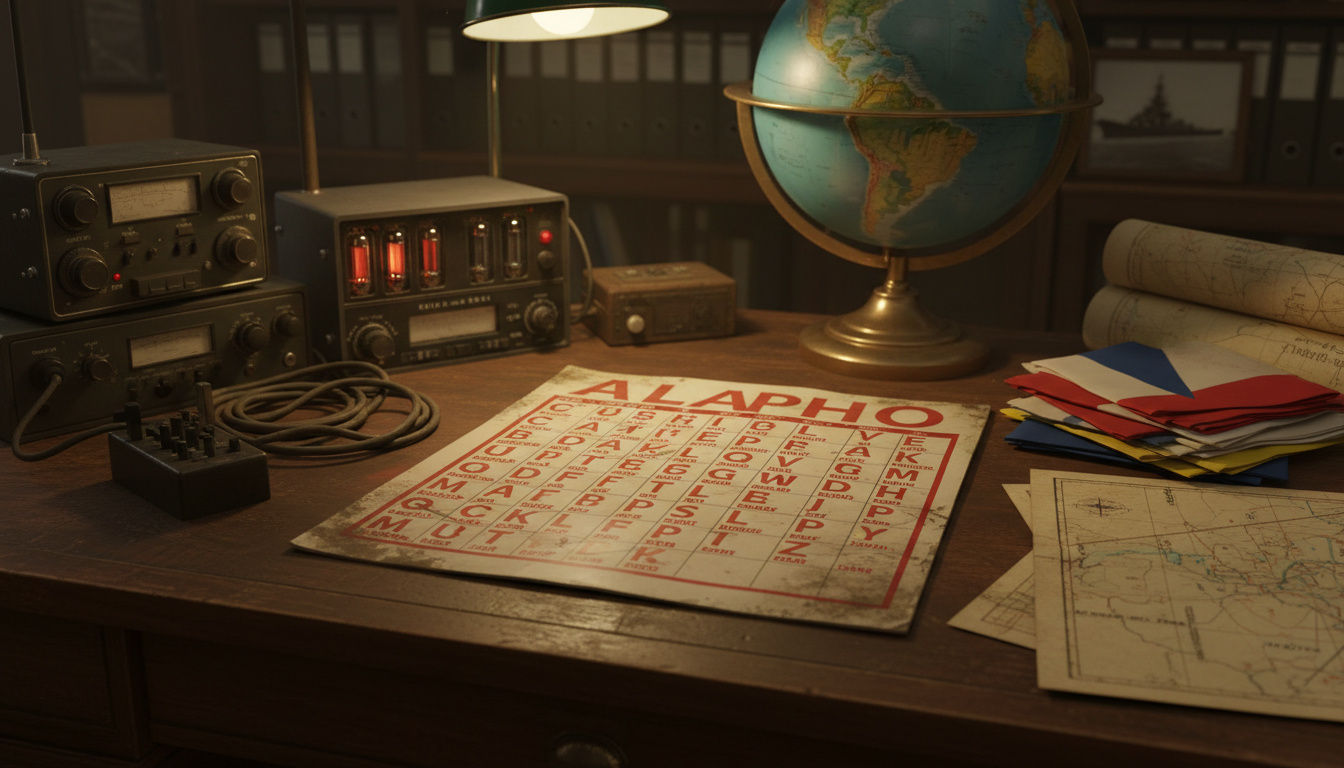

The NATO phonetic alphabet serves as the global standard for precise verbal communication across military, aviation, and emergency sectors. Officially known as the International Radiotelephony Spelling Alphabet, this system assigns distinct code words to each letter of the Latin alphabet to eliminate confusion during radio transmissions and telephone conversations in noisy environments.
Developed through international collaboration in the 1950s, the alphabet replaced earlier military systems that proved inadequate for multinational operations. Today, it remains essential for pilots, air traffic controllers, law enforcement, and telecommunications professionals who require unambiguous speech when clarity determines safety.
What Is the NATO Phonetic Alphabet?
Standardized spelling system used in aviation, maritime, and military operations worldwide
Finalized by ICAO and adopted by NATO on January 1, 1956, with minor revisions through March 1, 1956
Unique word assigned to each letter A through Z, selected for phonetic distinctness across languages
Prevents mishearing similar letters like B/D or M/N during high-stakes voice communication
- Cross-linguistic design: Words tested for clarity across English, French, and Spanish pronunciations
- Spelling safeguards: “Alfa” and “Juliett” use modified spellings to prevent non-English mispronunciations
- Numeric exceptions: Digits 3, 4, 5, and 9 use distinct pronunciations (TREE, FOW-ER, FIFE, NINER)
- Scientific testing: Harvard Psycho-Acoustic Lab contributed to 1955 clarity testing before finalization
- Global mandate: International Telecommunication Union mandated the alphabet in 1959 radio regulations
- Unchanged standard: The word list has remained constant since March 1956
| Attribute | Specification |
|---|---|
| Official Name | International Radiotelephony Spelling Alphabet |
| Common Names | NATO phonetic alphabet, ICAO phonetic alphabet |
| Governing Authority | ICAO (specification), NATO (military adoption) |
| Adoption Date | January 1, 1956 (finalized March 1, 1956) |
| Letter Coverage | A through Z (26 code words) |
| Numeric Coverage | 0-9, plus 100 and 1000 |
| Primary Users | Military, aviation, maritime, emergency services, amateur radio |
| Predecessor System | US “Able Baker” Joint Army/Navy alphabet (1940s) |
Complete NATO Phonetic Alphabet List A-Z
The NATO phonetic alphabet assigns specific words to each letter to ensure clear transmission. Each word starts with the sound of the letter it represents.
Letter Designations and Pronunciations
| Letter | Code Word | Pronunciation |
|---|---|---|
| A | Alfa | AL-FAH |
| B | Bravo | BRAH-VOH |
| C | Charlie | CHAR-LEE |
| D | Delta | DELL-TAH |
| E | Echo | ECK-OH |
| F | Foxtrot | FOKS-TROT |
| G | Golf | GOLF |
| H | Hotel | HOH-TEL |
| I | India | IN-DEE-AH |
| J | Juliett | JEW-LEE-ETT |
| K | Kilo | KEY-LOH |
| L | Lima | LEE-MAH |
| M | Mike | MIKE |
| N | November | NO-VEM-BER |
| O | Oscar | OSS-CAR |
| P | Papa | PAH-PAH |
| Q | Quebec | KEH-BEK |
| R | Romeo | ROW-ME-OH |
| S | Sierra | SEE-AIR-AH |
| T | Tango | TANG-GO |
| U | Uniform | YOU-NEE-FORM |
| V | Victor | VIK-TAH |
| W | Whiskey | WISS-KEY |
| X | Xray | ECKS-RAY |
| Y | Yankee | YANG-KEY |
| Z | Zulu | ZOO-LOO |
Internationalization Features
The ICAO specification modified certain spellings to accommodate non-English speakers. “Alfa” replaces the English “Alpha” to ensure the “f” sound in languages where “ph” might create confusion. Similarly, “Juliett” employs a double-t to prevent French speakers from pronouncing it as “Juliet,” while “Xray” removes the hyphen from the original “X-ray” designation.
Official ICAO recordings distributed to member states in November 1955 emphasize distinct syllable separation. For example, “November” requires three clear syllables (NO-VEM-BER) rather than colloquial contractions to ensure recognition across varying radio qualities and speaker accents.
How to Use the NATO Phonetic Alphabet
Spelling Procedures
Operators spell words letter-by-letter, preceding each transmission with the full alphabet word. For example, to transmit “NASA,” the speaker says: “November Alfa Sierra Alfa.” This method prevents confusion between similar-sounding letters such as B and D, or M and N, which become “Bravo” and “Delta,” or “Mike” and “November” respectively.
Transmission Protocols
Standard practice requires speaking clearly and at moderate speed. The alphabet proves particularly valuable when mixed nationalities operate together, as varying English accents might render standard letter names ambiguous. Military, aviation, amateur radio, and emergency services personnel rely on this system to avoid critical errors in coordinates, call signs, and operational codes.
NATO Phonetic Alphabet for Numbers and Variations
Numeric Designations
Digits utilize English number names with modified pronunciations for acoustic clarity. Multi-digit numbers transmit as individual digits rather than combined values.
| Number | Word | Pronunciation |
|---|---|---|
| 0 | Zero | ZE-RO |
| 1 | One | WUN |
| 2 | Two | TOO |
| 3 | Three | TREE |
| 4 | Four | FOW-ER |
| 5 | Five | FIFE |
| 6 | Six | SIX |
| 7 | Seven | SEV-EN |
| 8 | Eight | AYT |
| 9 | Nine | NINER |
| 100 | Hundred | HUN-DRED |
| 1000 | Thousand | THOU-ZAND |
When transmitting decimal points, speakers insert the word “decimal” between digits. For example, coordinates reading 3.14 become “tree decimal wun fow-er.” This protocol prevents confusion with the word “point,” which might be mistaken for other commands in high-noise environments.
Variations from Law Enforcement Systems
While the ICAO/NATO standard remains universal for international aviation and military use, some local law enforcement agencies historically employed modified versions. The LAPD traditionally utilized a different police alphabet (including “Adam” for A and “Boy” for B), though specific current standards for local departments remain unconfirmed in available documentation. Early military variants included German adaptations using “Dora” for D and American systems using “Dog” for D during World War II.
No official printable PDF charts were identified in available records, though current ICAO and NATO websites maintain digital versions of the standard. The core ICAO/NATO/ITU specifications remain consistent globally, with no major official variants permitted for international aviation or maritime use.
History and Origin of the NATO Phonetic Alphabet
The evolution of phonetic alphabets spans from early aviation experiments to the standardized system used today.
- 1920s: Early phonetic alphabets emerge for aviation, including ITU city-based versions used by international telecommunication operators.
- 1940s: United States military adopts the “Able Baker” Joint Army/Navy alphabet, using English words like “Able” for A and “Baker” for B, later criticized for Anglocentric bias.
- 1943: The Combined Communications Board (US-UK-Australia) develops a joint version to improve Allied interoperability.
- 1951: Civil aviation authorities revise the alphabet, with changes effective April 1952.
- 1955: ICAO conducts final laboratory testing with input from the Harvard Psycho-Acoustic Laboratory. Audio recordings distribute to member states in November 1955.
- 1956: NATO adopts the standard on January 1, finalizing minor tweaks (including “Charlie” over “Coca”) by March 1, 1956.
- 1959: The International Telecommunication Union mandates the alphabet in international radio regulations for global military, aviation, and maritime use.
Standardization Certainties and Documentation Gaps
| Established Information | Information Remaining Unclear |
|---|---|
| The 26-letter word list has remained unchanged since March 1, 1956 | Current specific LAPD phonetic standards (historical “Adam/Boy” system referenced but unconfirmed in recent official documentation) |
| ICAO maintains official specification ownership | Availability of specific printable PDF formats from official NATO distribution channels |
| ITU radio regulations govern global mandatory use | Extent of current local law enforcement variations from the international standard |
| Distinct pronunciations established for digits 3, 4, 5, and 9 | Detailed comparative analysis between NATO and current non-ICAO military alphabets used by non-member nations |
Context and Contemporary Usage
The alphabet emerged from the need to prevent catastrophic miscommunication in international aviation and military operations. Unlike the earlier “Able Baker” system, which relied heavily on English-centric words, the NATO standard selected words with phonetic distinctness across multiple languages including English, French, and Spanish. This linguistic neutrality proves critical when pilots from different nations communicate with air traffic control towers or when military units coordinate across language barriers.
Modern applications extend beyond traditional military and aviation contexts. Telecommunications technicians, emergency dispatchers, and customer service representatives handling international calls adopt the system to clarify spelling of names, addresses, and confirmation codes. For travelers concerned with international safety protocols, the Bali Travel Warning – 2024 Advisories and Safety Guide provides context on communication standards in high-traffic destinations where clear verbal transmission remains essential.
The system’s design specifically accounts for high-noise environments where similar-sounding letters create fatal confusion. Words like “Whiskey” and “Xray” offer acoustic profiles distinct from one another and from numeric transmissions, reducing error rates in GPS coordinate relay, aircraft call signs, and maritime distress communications.
Historical Documentation and Standards
Phonetic alphabets originated in the 1920s for aviation and evolved through World War II, with the US “Able Baker” alphabet used from the 1940s but criticized for English bias and confusable words.
NATO adopted [the alphabet] January 1, 1956, with minor tweaks (e.g., Charlie over Coca), finalized March 1, 1956, following ICAO definition after lab testing with Harvard Psycho-Acoustic Lab input.
Essential Points About the NATO Phonetic Alphabet
The NATO phonetic alphabet represents one of the most successful standardization efforts in international communication, remaining virtually unchanged since 1956. Its scientifically-tested word selection provides crucial clarity across linguistic boundaries in aviation, military, and emergency operations. For those interested in historical military culture from the era when this alphabet became standardized, the television series I Dream of Jeannie – Cast, Episodes and Legacy Guide offers a glimpse into the military context of the 1950s and 1960s.
Frequently Asked Questions
Is there a printable NATO phonetic alphabet chart?
Official charts are available through NATO and ICAO documentation, though specific printable PDF formats vary by distribution channel. Aviation training materials and military field manuals regularly reproduce the standard A-Z list and numeric pronunciations for reference.
What is the official source for the NATO phonetic alphabet?
The International Civil Aviation Organization (ICAO) maintains the official specification, originally defined in 1956. NATO adopted and standardized the alphabet for military use, publishing official charts and guidance documents on their website.
Why does the NATO alphabet use “Alfa” instead of “Alpha”?
The spelling “Alfa” ensures French and Spanish speakers pronounce it with an “f” sound rather than the “ph” digraph used in English, reducing international miscommunication during multinational operations.
Can civilians use the NATO phonetic alphabet?
Yes, the alphabet sees widespread civilian use in aviation, amateur radio, emergency services, and telecommunications. No restrictions limit its use for clear communication.
How do you spell “NASA” using the NATO phonetic alphabet?
Each letter represents a word: November (N), Alfa (A), Sierra (S), Alfa (A). Speakers pronounce each word clearly when transmitting over radio or telephone.
What is the NATO word for the number 9?
The digit 9 transmits as “Niner” to distinguish it from the German word “Nein” and ensure clarity across international communications.
Related stories



Megan Nguyen covers culture, lifestyle and society across Australia for Australia Pulse.