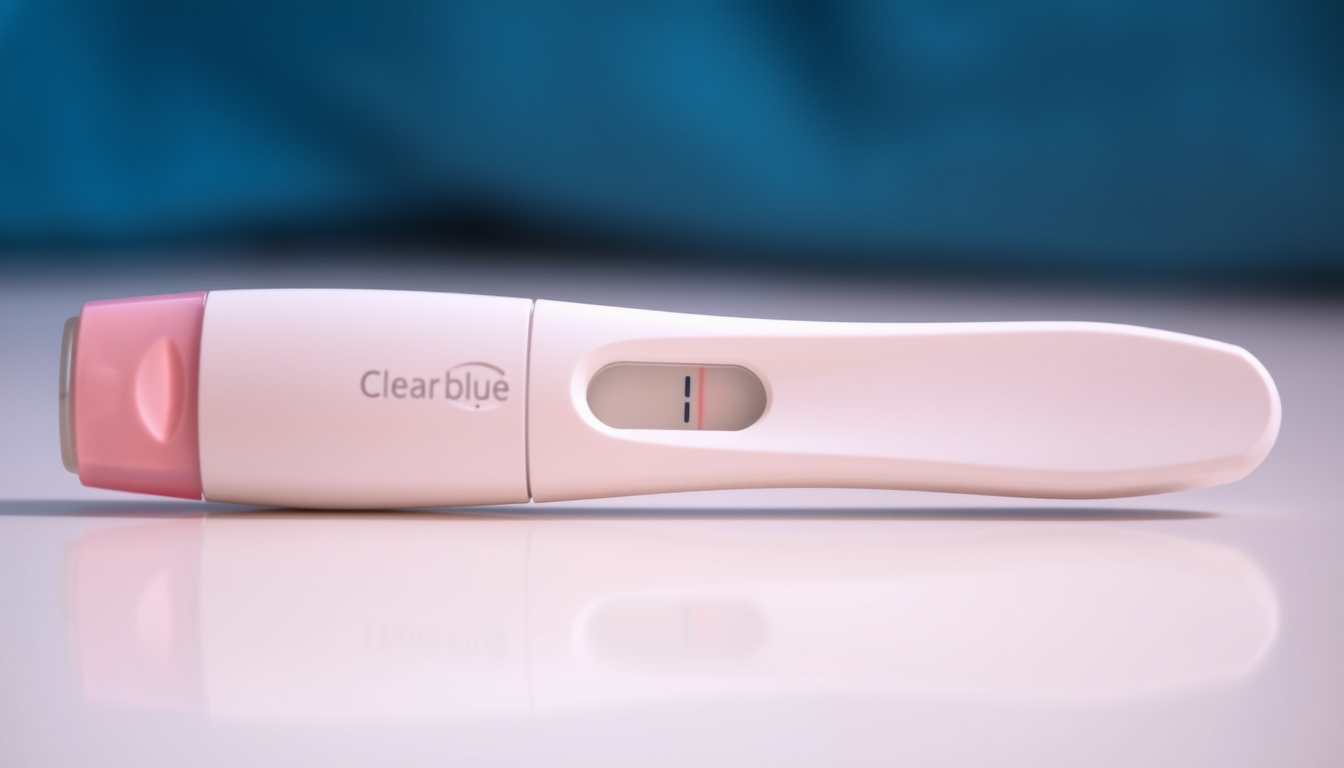

If you’ve ever waited three minutes staring at a pregnancy test, you know that feeling can’t be rushed. Clearblue has become the go-to brand for millions, but the fine print on “6 days before your missed period” deserves a closer look.
Accuracy (from missed period day): Over 99% ·
Earliest test window: 6 days before missed period ·
Result time: 1–3 minutes ·
hCG sensitivity (Ultra Early): 10 mIU/mL ·
Test variants: 3 main types
Quick snapshot
- Clearblue tests are over 99% accurate from the day of your expected period (Clearblue (official manufacturer)).
- Ultra Early test can detect hCG levels as low as 10 mIU/mL (Boots Ireland (retailer)).
- Clearblue’s Ultra Early test detects about 78% of pregnancies 6 days before missed period (Clearblue (product page)).
- Individual hCG rise varies, so a negative result before the missed period is not definitive (Clearblue (official site)).
- Clearblue Ultra Early detects about 78% of pregnancies 6 days before missed period (Fertility Store Ireland (specialist retailer)).
- Digital result shows “Pregnant” for up to one month (Clearblue (product guide)).
- If you get a “Not Pregnant” but your period doesn’t arrive, retest after three days (Clearblue (retesting advice)).
- For Irish readers: the HSE advises confirming positive results with a GP. (Clearblue (retesting advice))
Five key specs define how these tests work — the pattern: one universal accuracy claim, but different sensors for different budgets.
| Specification | Value |
|---|---|
| Accuracy (from missed period day) | Over 99% (Clearblue) |
| Earliest test | Clearblue Ultra Early – 6 days before missed period |
| Result time | 1–3 minutes depending on test |
| Result display | Digital (words or weeks) or line-based |
| hCG sensitivity | 10 mIU/mL (Ultra Early) – 25 mIU/mL (Early Digital) |
How early can a Clearblue detect pregnancy?
What is the earliest day you can test with Clearblue?
- The Ultra Early test can be used up to 6 days before your missed period (5 days before the expected period) (Clearblue (official site)). At that early point, it detects about 78% of pregnancies (Clearblue product page).
- The standard Early Digital test has a sensitivity of 25 mIU/mL, while the Ultra Early variant goes as low as 10 mIU/mL (Boots Ireland).
Why this matters: Testing before the missed period trades certainty for speed. If you test at 6 days early and get a negative, you may still be pregnant — just not enough hCG yet.
The 78% detection rate at 6 days early means roughly one in five women who test that early will receive a false negative — a statistic that surprises many first-time users.
How many days before your missed period?
Clearblue defines “6 days before missed period” counting from the day you expect your period. So if your cycle is 28 days, you can test on cycle day 23. Each day closer to the missed period raises the detection rate — by the day of the missed period it reaches over 99%.
Does Clearblue detect pregnancy 6 days before?
Yes — but not for everyone. Clinical data from the brand shows that 78% of pregnant women who tested 6 days early got a positive result (Fertility Store Ireland). That leaves 22% who have to wait a few more days.
If you test early and get “Not Pregnant”, don’t assume you’re out. The HSE recommends waiting until after your missed period for the most reliable result.
The implication: Early testing trades certainty for speed, so waiting until your missed period reduces false negatives.
When should I take a Clearblue pregnancy test?
Should I test first thing in the morning?
- For early testing (before your missed period), Clearblue recommends using first morning urine because it contains the highest concentration of hCG (Clearblue guide).
- Avoid drinking large amounts of liquid beforehand — it can dilute the urine and lower hCG levels (Clearblue how-to).
Can I test at any time of day?
Once you’ve passed the day of your missed period, yes. Clearblue says you can test at any time of day after that point (Clearblue early detection page). The hCG level is typically high enough by then to be detected regardless of urine concentration.
How long after missed period should I wait?
If you want the highest possible accuracy, wait until the day of your missed period or later. The 99%+ accuracy figure applies from that day onward. Testing earlier increases the chance of a false negative.
The trade-off: Early testing gives you a head start on planning, but it introduces uncertainty that can be stressful. For most women, waiting the extra couple of days is statistically safer.
Can Clearblue give a false positive?
What causes a false positive on Clearblue?
- False positives are rare — under 1% for Clearblue tests (Clearblue official claims).
- Potential causes: recent miscarriage, fertility drugs containing hCG, some medical conditions (e.g., ovarian cysts), or user error (reading the result after the display window has faded).
- Evaporation lines can appear on line tests if read after the recommended time, but digital tests eliminate that issue.
Can chemical pregnancy cause false positive?
A chemical pregnancy — where a fertilised egg implants but fails to develop — will still produce enough hCG for a positive result. This is technically a true positive for that pregnancy, but the pregnancy doesn’t progress. It’s not a “false” positive, but it can be confusing.
How often do false positives happen?
Clearblue reports a false-positive rate of less than 1% in clinical studies. That’s one in every hundred tests at most. If you get a positive and suspect it might be wrong, wait two days and retest, or see your GP for a blood test.
False positives are uncommon with digital Clearblue tests because the sensor reads hCG directly. But if you have recently taken fertility drugs containing hCG, the result may be invalid — check the label.
The pattern: False positives are rare, but always confirm with a healthcare professional if in doubt.
Can you mess up a pregnancy test?
What are common mistakes when using Clearblue?
- Using the test after its expiration date — the chemicals degrade and results become unreliable.
- Reading the result outside the 3-minute window. Clearblue says the “Not Pregnant” result disappears after about 24 hours, but a “Pregnant” result may remain visible for a month — if you read it hours later, you might misinterpret an old result (Clearblue early detection page).
- Disassembling the test. The internal dye system can be disturbed, giving a false reading.
- Touching the absorbent tip with fingers — oils or dirt can interfere with the reaction.
How to avoid invalid results?
Follow the instructions exactly: hold the test in the urine stream for 5 seconds (or dip for the specified time), lay it flat, and read it between 1 and 3 minutes. Do not shake or tilt the test.
What does an invalid result look like?
A digital test will show “Invalid” or an error symbol. A line test may show no control line at all. If that happens, call the Clearblue helpline — it’s usually a one-use issue, and they may replace it.
Why this matters: User error is the leading cause of inaccurate results. The test itself is reliable; the human factor is where most problems start.
Is 1/2 weeks pregnant actually 4 weeks?
How does Clearblue weeks indicator work?
The Clearblue Digital with Weeks Indicator measures hCG levels to estimate the number of weeks since conception. It displays “1-2”, “2-3”, or “3+” weeks. This is not the same as the gestational age used by doctors.
What do 1-2, 2-3, 3+ weeks mean?
- 1-2 weeks since conception corresponds to about 3-4 weeks gestational age (calculated from the last menstrual period).
- 2-3 weeks since conception = about 4-5 weeks gestational age.
- 3+ weeks since conception = about 5+ weeks gestational age.
This discrepancy often confuses users. The Clearblue scale adds roughly two weeks compared to the LMP method used in clinics (Clearblue explanation).
Why does Clearblue show 1-2 weeks when you are 4 weeks?
Because conception generally occurs about two weeks after the start of your last period. So if you are 4 weeks pregnant by the standard LMP count, you are only about 2 weeks past conception — which matches Clearblue’s reading. It’s not wrong, it’s a different reference point.
The implication: If you see “1-2 weeks” on the display, you are in early pregnancy. Don’t panic that it’s lower than your calculation. Discuss with your midwife or GP which dating method they use.
Comparison of Clearblue test variants
Three main models, one obvious gap: only the Ultra Early offers 10 mIU/mL sensitivity — worth paying extra for if you test early.
| Feature | Ultra Early Digital | Digital with Weeks Indicator | Rapid Detection |
|---|---|---|---|
| Result type | Digital (“Pregnant/Not Pregnant”) | Digital + weeks estimation | Line (plus/minus) |
| Earliest test | 6 days before missed period | Day of missed period | Day of missed period |
| Accuracy | Over 99% from missed period day | Over 99% from missed period day | Over 99% from missed period day |
| Result time | 1–5 minutes | 3 minutes | 1 minute |
| hCG sensitivity | 10 mIU/mL | 25 mIU/mL | 25 mIU/mL |
| Recommended for | Early testers | Those who want weeks estimate | Budget-conscious, after missed period |
The catch: Only the Ultra Early test offers the highest sensitivity for early detection.
How to use a Clearblue test (step‑by‑step)
Getting it right the first time saves you money and stress.
- Check the expiry date on the foil wrapper.
- Remove the test and take off the cap. Do not touch the absorbent tip.
- Hold the tip in your urine stream for 5 seconds (or dip into a collected sample as per instructions).
- Lay the test flat on a dry surface. Start timing.
- Wait the time specified in the product leaflet (usually 1–3 minutes). Read the result as soon as the timer is up.
- If digital, record the word or weeks. If line test, check for a control line first.
- Do not read the test after 10 minutes – results may be invalid.
Note: If you get “Not Pregnant” but your period still doesn’t come, retest in 3 days. hCG doubles roughly every 48 hours in early pregnancy.
Expert perspectives
All Clearblue pregnancy tests are clinically proven to be over 99% accurate from the day you expect your period.
Clearblue official website (Clearblue manufacturer)
If you test before your missed period, use first morning urine for the most reliable result.
Clearblue product guide (Clearblue early detection page)
The HSE advises waiting until after your missed period for the most reliable result.
HSE (Health Service Executive)
The pattern: Consistent guidance from manufacturer and health authorities emphasizes waiting for the missed period for best accuracy.
Summary
Clearblue tests deliver what they promise: a 99%+ detection rate once your period is due, and a legitimate but partial early-detection window. For Irish women buying a test at Boots or a pharmacy, the Ultra Early variant is the only one that can reliably pick up hCG at 10 mIU/mL — worth the extra few euro if you’re testing before your missed period. The standard Digital with Weeks Indicator is best for those who want both confirmation and a rough timeline, but be prepared to explain the two-week offset to your GP. The choice isn’t between accurate and inaccurate — it’s between speed and certainty. For anyone in Ireland waiting for that answer, the data says: wait until the day of your missed period if you can, and use first morning urine. Or test earlier and accept the higher false-negative rate — the science is clear, even if the result isn’t always.
Frequently asked questions
How long does a Clearblue test take to show results?
Between 1 and 3 minutes depending on the model. Rapid Detection shows the result in 1 minute; Digital tests take up to 3 minutes. Do not read after 10 minutes.
Can I reuse a Clearblue pregnancy test?
No. All Clearblue tests are single-use. Reusing any pregnancy test can give incorrect results due to dried urine or chemical residue.
Does Clearblue detect ectopic pregnancy?
Clearblue tests detect the presence of hCG, which is produced in an ectopic pregnancy as well. A positive result does not confirm that the pregnancy is in the uterus — see your GP for an ultrasound if you have pain or bleeding.
What does a faint line mean on a Clearblue test?
On a line test, a faint positive line usually indicates a low but detectable level of hCG — it is considered a positive result. Digital tests eliminate this ambiguity.
Can Clearblue detect twins?
No. The test cannot indicate twin or multiple pregnancies. Some women with very high hCG levels may see a stronger line or a “3+” weeks indicator, but that is not diagnostic.
Should I test again if I get a negative but still miss my period?
Yes. If you tested early and got a negative, wait three days and retest. If your period still hasn’t arrived and the test remains negative, consult your GP.
Do medications affect Clearblue results?
Fertility drugs containing hCG (e.g., some ovulation triggers) can cause false positives. Other common medications like painkillers, antibiotics, or birth control pills do not affect the test.

Grace Campbell leads fact-checking, source verification and corrections at Australia Pulse.