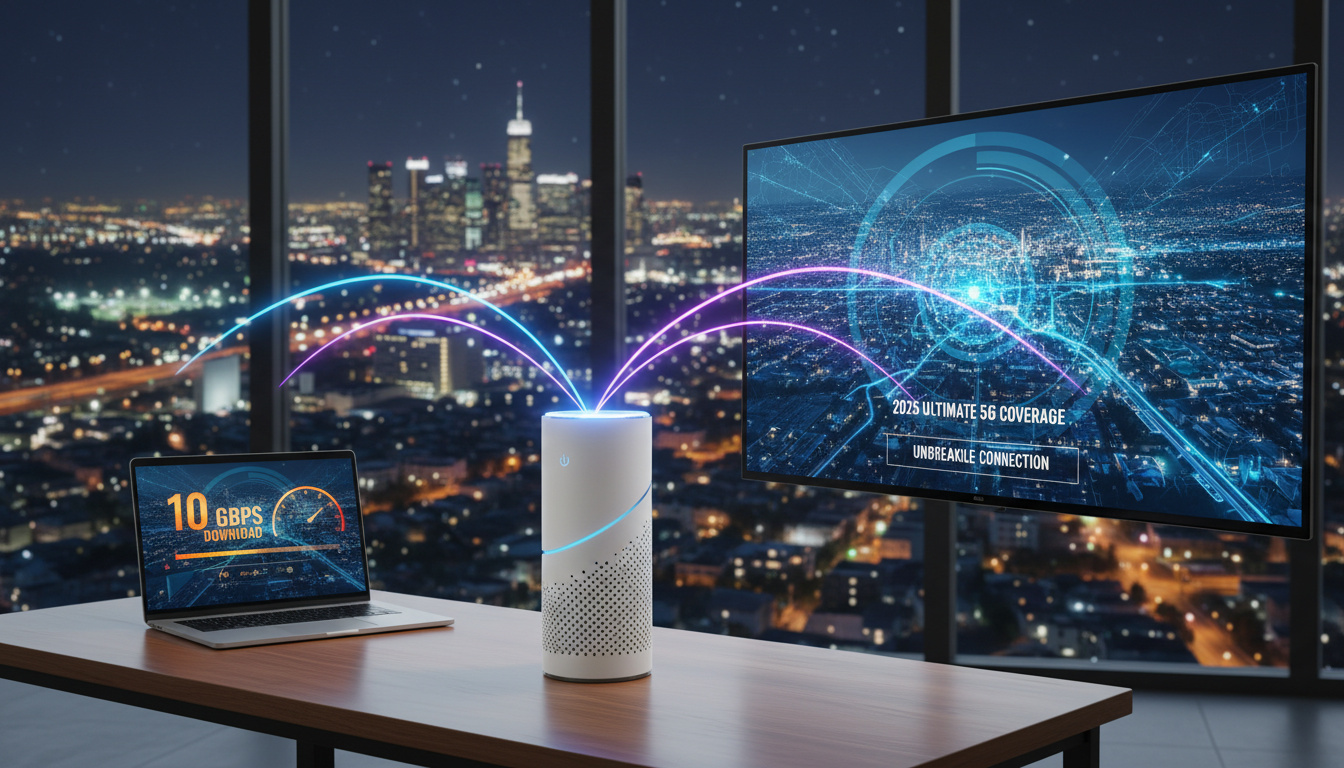

5G home internet delivers broadband through cellular airwaves rather than underground cables, promising speeds that rival traditional wired connections without installation crews digging up lawns. The service uses fixed wireless access technology to beam signals from nearby 5G towers into a gateway device inside your home, offering an alternative for households stranded by fiber shortages or cable monopolies.
Major carriers have expanded coverage aggressively since 2021, transforming 5G from a mobile phone perk into a legitimate residential service. Unlike satellite internet with its weather sensitivity and high latency, or DSL with its aging copper limitations, 5G home internet occupies a middle ground: faster than 4G, more flexible than fiber, and increasingly available in both dense cities and rural corridors.
What Is 5G Home Internet?
Fixed wireless broadband using 5G towers
87-498 Mbps download
T-Mobile, Verizon, AT&T
Rural homes without cable access
- No trenching or installation fees required
- Speeds vary significantly by tower proximity and network congestion
- Unlimited data plans are standard among major carriers
- Gateway equipment typically included at no extra cost
- Self-installation takes approximately 15 minutes
- Monthly rates range from $35 to $70 with AutoPay
- No long-term contracts lock in customers
| Metric | Typical Range | Notes |
|---|---|---|
| Download Speed | 87-498 Mbps | Peaks vary by provider |
| Upload Speed | 12-55 Mbps | T-Mobile leads at 12-55 |
| Latency | 20-50 ms | Comparable to cable |
| Price | $35-70/mo | Often includes taxes/fees |
| Data Cap | Unlimited | AT&T fixed wireless has 350GB cap |
| Contract | None | Month-to-month service |
| Installation | Self-install | 15-minute setup typical |
| Equipment | Gateway included | Wi-Fi 7 on premium plans |
Who Provides the Best 5G Home Internet Service?
T-Mobile leads as the top-rated 5G home internet provider in 2025 for its low pricing, superior reliability over Verizon and many cable/fiber options, and typical speeds of 87–498 Mbps download (12–55 Mbps upload), outperforming competitors in customer satisfaction surveys and real-world tests.
T-Mobile
The Rely plan costs $35–$50 monthly, while Amplified and All-In plans run $60–$70 with AutoPay. A five-year price guarantee protects against rate hikes. The service includes a Wi-Fi 7 gateway on premium tiers. Typical speeds range from 87–498 Mbps down and 12–55 Mbps up, with unlimited data standard.
Verizon
Service starts at $35 monthly with no contracts required. Verizon utilizes C-band 5G to balance reach and speed, delivering up to 300 Mbps depending on location. The unlimited data offering supports streaming and remote work without artificial caps.
AT&T
Fixed Wireless plans cost $47–$75 monthly for 100–300 Mbps speeds, though these carry a 350 GB monthly data cap. AT&T also markets fiber options with symmetrical speeds up to 5 Gbps for addresses where wireline infrastructure exists. Promotional reward cards occasionally offset initial costs.
T-Mobile offers a five-year price guarantee on select plans, with customer surveys confirming no rate hikes over two-year testing periods. Taxes and fees are included in advertised pricing.
How Fast Is 5G Home Internet in Real-World Use?
Download and Upload Performance
T-Mobile averages 318 Mbps in real-world tests, frequently exceeding advertised speeds of 254 Mbps. Verizon and AT&T fixed wireless generally reach up to 300 Mbps downloads. Mid-band 5G fixed wireless access typically delivers 100–300 Mbps downstream and 10–40 Mbps upstream.
Latency and Gaming
Low latency performance matches cable internet standards, supporting competitive gaming and high-definition video conferencing without noticeable lag. Testing reveals no performance drop versus wired connections at identical sites.
Consistency Under Load
Peak speeds run higher than averages, which typically settle between 100–300 Mbps. The technology suits streaming, gaming, and remote work, though speeds fluctuate based on network congestion and signal strength.
Where Can You Get 5G Home Internet?
Urban vs. Rural Availability
T-Mobile leverages the largest 5G network footprint. Verizon concentrates strength in urban C-band areas. AT&T offers broader fixed wireless and fiber hybrid options. Rural users increasingly access 5G as an alternative to satellite internet.
Checking Your Location
Availability varies dramatically by state. Maine and Arizona show different coverage patterns and speed capabilities. Provider websites offer address-specific qualification tools showing availability up to 300 Mbps.
Signal strength depends on proximity to 5G towers and physical obstructions. Promotional speeds up to 300 Mbps may not reflect actual availability at every address.
Performance and plan availability differ significantly across states. Some regions offer $10-15 monthly discounts as promotional incentives during initial rollout phases.
For a detailed breakdown of regional availability and provider comparisons, see 5G Home Internet – Providers Speeds Coverage Costs 2025.
How It Compares to Wired Options
5G fixed wireless access rivals or exceeds cable reliability without weather-related outages. Fiber offers symmetrical uploads up to 5 Gbps but requires physical installation and typically costs more. Most households do not require gigabit speeds unless managing 40 simultaneous HD streams.
How Has 5G Home Internet Service Evolved?
- : Verizon pilots 5G Home service in select markets
- : T-Mobile launches national 5G home internet service
- : AT&T expands fixed wireless access offerings
- : 5G-Advanced upgrades expected to enhance capacity
What Do We Know for Certain About 5G Home Internet?
| Established Facts | Remaining Uncertainties |
|---|---|
| No installation fees or trenching required | Exact speeds at specific addresses before testing |
| Self-setup takes approximately 15 minutes | Long-term network congestion during peak hours |
| Unlimited data on T-Mobile and Verizon plans | 5G-Advanced rollout timelines for rural markets |
| No contractual obligations | Equipment upgrade cycles for emerging standards |
Why Does Fixed Wireless Access Matter for Broadband Equity?
Fixed wireless access represents a critical bridge for broadband equity, delivering high-speed connectivity to regions where fiber deployment remains economically unfeasible. The technology bypasses the need for expensive underground infrastructure while offering superior performance to satellite alternatives.
Rural households previously limited to DSL or geostationary satellite now access speeds exceeding 100 Mbps through cellular towers. This shift reduces the digital divide without requiring municipal bonding for fiber trenching or reliance on cable monopolies.
What Do Industry Tests Reveal About 5G Home Internet?
“Always on, no lag, affordable”
— Customer feedback, HighSpeedInternet.com 2025 survey
“Outstanding experience”
— Customer feedback, HighSpeedInternet.com 2025 survey
Testing data confirms T-Mobile experienced zero outages over two years of continuous monitoring, with only one to two brief slowdowns monthly. The service outperformed cable reliability at identical test locations.
Is 5G Home Internet the Right Choice for Your Household?
Households lacking fiber access or seeking to escape cable contracts will find 5G home internet particularly compelling. The combination of straightforward setup, competitive pricing, and unlimited data suits families, remote workers, and gamers who prioritize reliability over theoretical maximum speeds. Those requiring symmetrical gigabit uploads for heavy content creation may still prefer fiber where available. For a broader comparison of providers and technical specifications, see 5G Home Internet – Providers Speeds Coverage Costs 2025.
Frequently Asked Questions
Does 5G home internet require a contract?
No. Major providers including T-Mobile, Verizon, and AT&T offer month-to-month service without early termination fees or long-term commitments.
What equipment is needed for 5G home internet?
Providers supply a gateway device that combines modem and router functions. Some premium plans include Wi-Fi 7-capable hardware. Self-installation requires no additional cabling.
How does weather affect 5G home internet?
Unlike satellite, 5G home internet rarely suffers weather-related outages. Heavy rain or snow may marginally reduce signal strength but typically maintains connectivity.
Can I use 5G home internet for gaming?
Yes. Latency rates of 20-50 milliseconds match cable performance, supporting competitive online gaming and video conferencing without noticeable lag.
Is 5G home internet faster than cable?
Real-world tests show T-Mobile 5G averaging 318 Mbps, often exceeding cable provider speeds in the same locations. However, cable offers more consistent speeds during peak congestion.
Does 5G home internet have data caps?
T-Mobile and Verizon offer unlimited data. AT&T fixed wireless plans impose a 350 GB monthly cap, while their fiber and 5G alternatives carry no limits.
How long does installation take?
Self-installation requires approximately 15 minutes. Users plug in the gateway, follow app-based setup instructions, and position the device near a window for optimal signal.
Can I get 5G home internet in rural areas?
Availability expands rapidly in rural markets. Coverage depends on proximity to 5G towers. Check provider maps for specific address qualification.
Related stories



Megan Nguyen covers culture, lifestyle and society across Australia for Australia Pulse.