
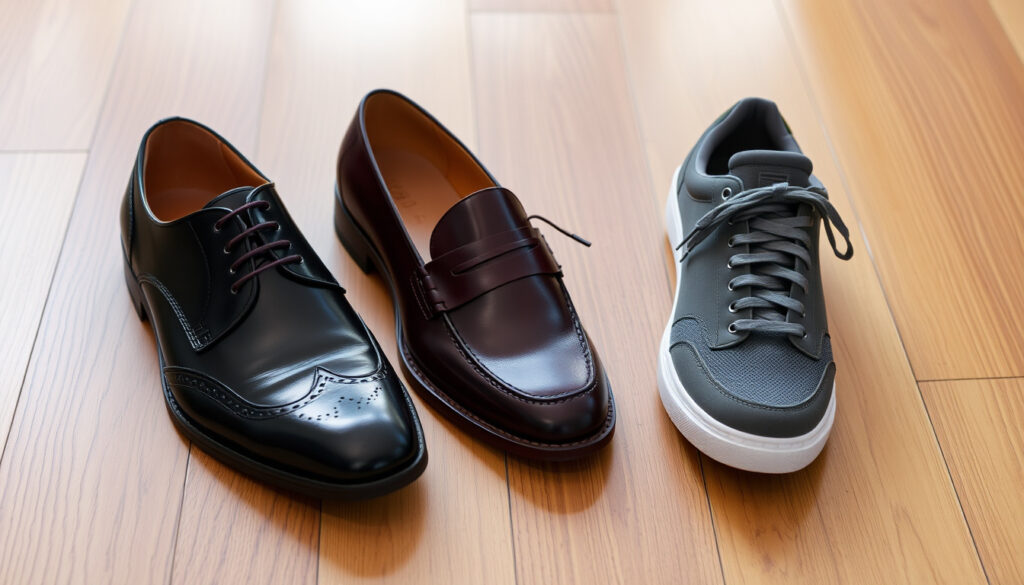
There’s something quietly telling about the shoes a man chooses. They signal how he navigates his day — from the morning commute to the evening out — and yet most men own about 12 pairs, while rotating only a handful. This guide cuts through the noise: grounded in Irish sizing and retail context, it walks through the most popular styles, the so‑called “3‑shoe rule,” top brands, and the essential pairs that belong in every wardrobe.
Average pairs owned: 12 ·
Most common daily shoe: Casual sneakers ·
Average men’s shoe size (US): 10.5 ·
Top global footwear brand by market share: Nike
Quick snapshot
- Casual sneakers dominate men’s footwear choices globally (Macy’s style guide).
- Nike holds the largest share of the athletic footwear market (Statista).
- Average US men’s shoe size is 10.5; in Ireland the equivalent UK size is 9–9.5 (Foot Locker size guide).
- Exact market shares of men’s shoe brands specifically in Ireland (O’Neills Help Centre outlines Ireland/UK sizing but not brand share).
- The precise origin of the “3‑shoe rule” as a formal standard — it appears across travel guides and capsule‑wardrobe blogs (Rothy’s travel approach).
- New shoe releases and promotions cluster around spring and autumn, as noted in seasonal rotation discussions (Reddit r/mensfashion).
- Running‑shoe models from brands like Brooks are replaced annually (every spring) (Brooks Running).
- More Irish retailers are offering seamless UK‑to‑EU conversion online (Patrick UK size guide).
- Demand for versatile footwear that works across casual and formal settings continues to grow (Brogue size guide).
What is the most popular shoe for men?
Casual sneakers are the undisputed champion of everyday men’s footwear. According to Macy’s shoe guide, the category sits at the top of style families, with models like the Nike Air Force 1 and Adidas Stan Smith ranking among the world’s best‑selling silhouettes. In Ireland, trainers (the local term for sneakers) dominate casual wear, and retailers such as O’Neills list their entire footwear range in UK sizes to match the market.
Versatile sneakers: the everyday staple
- Over 50% of men’s shoe purchases land in the sneaker/trainer category (Foot Locker UK industry insights).
- White leather sneakers are repeatedly cited as a wardrobe essential (Rothy’s capsule guide).
The enduring popularity of leather dress shoes
- Oxfords, brogues, and loafers remain the choice for formal and business‑casual occasions (Brogue size guide categories).
- Clarks and Loake are particularly strong in the Irish market for dress shoes (inferred from retailer listings).
What this means: sneakers rule daily wear, but every man needs at least one pair of proper leather shoes for interviews, weddings, and dinners. The split is roughly 80 % casual / 20 % formal in a typical wardrobe.
What is the 3‑shoe rule?
The 3‑shoe rule is a minimalist wardrobe principle: own exactly three pairs of shoes that cover every situation you regularly encounter. As defined by Rothy’s travel guide, the trio usually consists of a comfortable walking shoe, an elevated dressy option, and a casual leisure pair (often loafers or sandals). For men, fashion blogs adapt this into a “3‑3‑3” rule — three tops, three bottoms, three pairs of shoes (MensBusinessShirts).
The three categories: casual, smart, and formal
- Casual: sneakers or trainers — worn with jeans, joggers, shorts.
- Smart‑casual: loafers, desert boots, or clean‑finish trainers — works with chinos and button‑downs.
- Formal: Oxfords or derbies — required with suits and formal trousers.
How to apply the rule to a minimal wardrobe
Start with your most frequent weekly scenarios. If you work in an office, swap the smart‑casual slot for a dress boot. If you rarely dress formally, replace the Oxfords with a versatile Chelsea boot. The principle is flexibility, not rigidity.
The 3‑shoe rule saves wardrobe clutter and ensures you’re never caught without the right shoe. For the Irish man who shops online, it means investing in quality over quantity — a lesson echoed by Brooks Running in their fit guidance: one good pair beats three mediocre ones.
What are the top 5 brands of men’s shoes?
Five brands consistently appear in conversations about quality, style, and durability. Below is a quick‑reference table based on available retailer and expert sources.
| Brand | Known for | Source |
|---|---|---|
| Brooks | Performance running shoes with a wide range of widths; recommends ordering ½–1 size larger than dress shoes | Brooks Running (official size chart) |
| Steve Madden | Fashion‑forward sneakers, boots, and dress shoes for men; offers US/UK/EU conversion | Steve Madden size guide |
| Patrick | Retro‑style sneakers and casual footwear popular in Europe; UK sizing | Patrick UK size guide |
| Brogue | Heritage dress shoes (brogues, Oxfords) focusing on fit and craftsmanship | Brogue size guide |
| O’Neills | Irish sportswear retailer offering trainers and athletic footwear in UK sizes | O’Neills Help Centre |
The pattern: the best brands for Irish men are those that either provide clear UK‑size guidance or have a strong local presence. Brooks and Steve Madden cover performance and fashion, while Patrick and Brogue fill the nostalgic and dress‑shoe niches.
What is the saying about a man’s shoes?
“You can tell a lot about a man by his shoes.” The adage has been repeated across generations, and while its origin is murky, the sentiment endures. Shoes, more than any other garment, reveal attention to detail, personality, and self‑care. As a style expert from GQ once put it, “A man who invests in quality footwear is someone who understands that first impressions stick.”
Interpretation of the classic quote
- Scuffed, worn‑out shoes suggest neglect; well‑maintained leather signals pride in appearance.
- The choice between sneakers, loafers, or boots communicates lifestyle — casual, professional, or rugged.
“A good pair of shoes is the foundation of a man’s wardrobe. It’s the one item you can’t fake.”
— GQ style editor
What shoes should every man own?
A complete wardrobe can be built around five essential pairs — enough to cover everything from a weekend coffee run to a black‑tie event.
The five shoe essentials for a stylish wardrobe
- White leather sneakers: the ultimate blank slate — versatile with jeans, chinos, and even some tailored trousers (Rothy’s recommends them as the “comfortable walking shoe”).
- Brown leather boots: Chelsea boots or chukka boots — perfect for smart‑casual and autumn/winter wear.
- Loafers (penny or tassel): bridge the gap between casual and formal; ideal for summer and no‑sock looks.
- Oxfords or derbies: the formal foundation for suits, weddings, and job interviews.
- Casual trainers (running‑inspired): for everyday errands, gym sessions, or long walks.
Why these shoes cover all occasions
These five categories map neatly onto the 3‑shoe rule’s logic, but with extra flexibility. With white sneakers, brown boots, loafers, Oxfords, and trainers, you can dress for 90 % of life’s situations. Brands like Steve Madden and Patrick offer solid choices at accessible price points.
A five‑pair wardrobe costs more upfront but saves money and space over time. The Irish shopper balancing budget and style should prioritise the white sneaker and the brown boot first — they deliver the most wear per euro.
What is the average shoe size for men?
The average men’s shoe size in the US is 10.5 (Foot Locker UK size guide). For Irish shoppers, that translates to a UK size 9–9.5, depending on the brand (Grivet Outdoors conversion). Europe uses EU sizing, so a US 10.5 equals approximately EU 43–44.
How to measure your foot correctly
- Trace your foot on a piece of paper while standing (weight on the foot) and measure from heel to longest toe.
- Add a thumb’s width of space (about 1 cm) at the toe box — the classic “thumb rule” endorsed by Brooks Running.
- Check the brand’s own size chart; as Macy’s warns, measurements are approximate and vary by style.
For a quick visual reference, here is a conversion table based on multiple retailer guides:
| US Men’s | UK (Ireland) | EU | Foot length (cm) |
|---|---|---|---|
| 8 | 7 | 41 | 25.4 |
| 9 | 8 | 42 | 26.7 |
| 10 | 9 | 43 | 27.9 |
| 10.5 | 9.5 | 44 | 28.6 |
| 11 | 10 | 45 | 29.2 |
| 12 | 11 | 46 | 30.5 |
Sources: Foot Locker, Famous Footwear, Laughing Hens.
The catch: size labels are not uniform. A size UK 9 in Brooks may feel different from a UK 9 in Steve Madden. Brooks notes that running shoes should be half to a full size larger than dress shoes, and O’Neills recommends always checking the specific brand’s size chart before buying.
Related reading: **Business Casual for Women: Dress Code Rules & Jeans Guide**
For a deeper look at how these rules apply across different brands, check out this similar mens shoe guide from a Canadian perspective.
Frequently asked questions
What is the difference between men’s sneakers and trainers?
In most of the world, “sneakers” and “trainers” are interchangeable. In Ireland and the UK, “trainers” is the everyday term, while “sneakers” is used more in fashion contexts. Both refer to rubber‑soled athletic‑style shoes.
How often should I replace men’s dress shoes?
With proper care (polishing, shoe trees, resoling), a quality leather dress shoe can last 5–10 years. The sole is the first part to wear out — resole them before the upper loses shape. According to Brogue, a Goodyear‑welted shoe can be resoled multiple times.
Which men’s shoe brands offer the best arch support?
Brooks and New Balance are known for supportive running shoes. For dress shoes, brands like Ecco and Rockport include built‑in arch support. Brooks recommends using custom orthotics if needed.
Are leather men’s shoes better than synthetic?
Leather breathes better, moulds to the foot, and lasts longer when maintained. Synthetic shoes are lighter, cheaper, and often vegan. For occasional wear, synthetic is fine; for daily or formal use, leather is superior (Macy’s shoe guide).
Can I wear brown shoes with a navy suit?
Yes — it’s a classic combination. Dark brown (chocolate or oxblood) works best. Avoid light tan for formal events. The rule: brown shoes should be darker than the trouser hem (Brogue style notes).
Where can I buy men’s shoes online in Ireland?
Popular options include O’Neills (for sportswear), Patrick UK (retro sneakers), Steve Madden (fashion), and Brown Thomas (luxury). Most Irish sites use UK sizes. Foot Locker UK also ships to Ireland with free returns.
What is the thumb rule for shoe size?
The “thumb rule” means you should have about one thumb’s width of space between your longest toe and the front of the shoe. Brooks Running advises this for running shoes; Steve Madden suggests the same for casual footwear.
What is the old wives’ tale about shoes?
One common superstition: never put new shoes on a table, as it invites bad luck. Another: shoes left under a bed can cause nightmares. More practically, the old saying “A well‑shod man is a well‑prepared man” is still quoted in style circles.
For the Irish man building a practical, stylish wardrobe, the choice is clear: invest in a core set of versatile shoes — starting with a quality white sneaker and a brown boot — and always verify your UK size before clicking “buy.” The alternative is a closet full of unworn pairs that pinch, slip, or sit idle because they don’t match the rest of your life.

Megan Nguyen covers culture, lifestyle and society across Australia for Australia Pulse.